The agent system

One strategy has to account for ten connected areas that keep changing.

Models get the headlines. The business result also depends on people, data, providers, tools, infrastructure, security, cost, and what happens after deployment. We manage the decisions across the whole system.

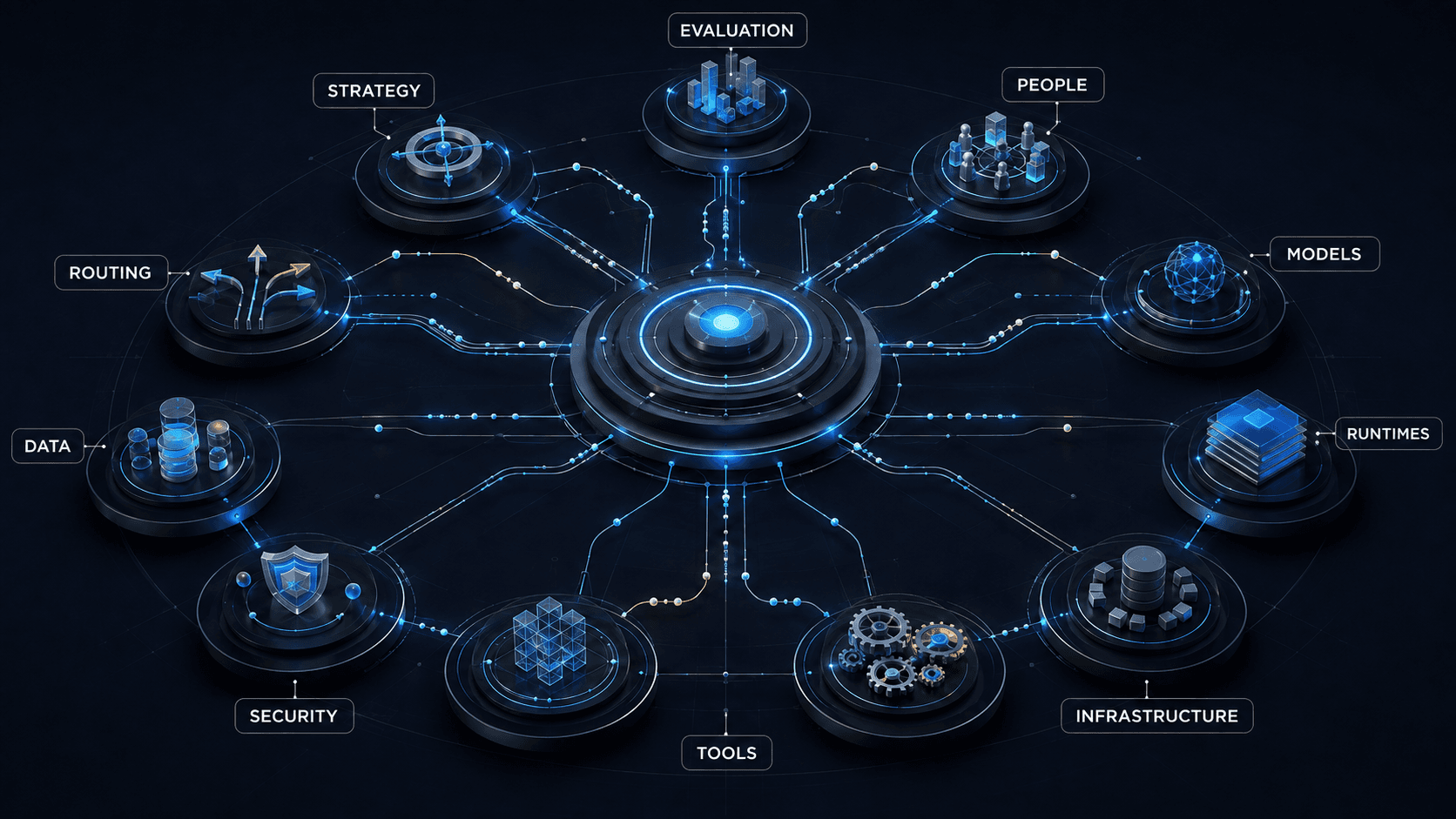
A central orchestration system connecting ten specialized parts of a multi-agent ecosystem
A multi-agent system is not one tool. It is a set of connected decisions that has to work as one.
Why this keeps changing

A good decision today still needs maintenance.

A change in one area can affect security, cost, reliability, workflow, and the original business case. We track the chain instead of treating each new release as an isolated event.

Models

Capability, speed, cost, context, tool use, privacy, and retirement dates change the choices available.

Providers and routers

Availability, fallbacks, regional access, data policies, and pricing can change without the model changing.

Runtimes and work surfaces

Codex, Claude Code, VS Code, Antigravity, OpenClaw, Hermes, and the next entrant keep changing how agents work.

Infrastructure and tools

Hosts, databases, queues, connectors, plugins, and protocols can make an old idea practical or create a new dependency.

The domain map

The whole system, organized around business decisions.

These areas overlap. We separate them so the company can see what it has decided, what still needs an owner, and what a new release may affect.

01

Business strategy

Connect every agent decision to a business priority, an owner, a budget, and a result worth measuring.

Opportunity discoveryUse-case scoringBuild, buy, partner, or waitPortfolio prioritiesFunding and ownershipExpansion and stop decisions
02

Work and people

Learn the real work from the people who do it, including the exceptions that never made it into the process manual.

SME interviewsWorkflow mappingException discoveryHuman review and takeoverTraining and adoptionRole and process changes
03

Models and inference

Choose models by how they perform on the client's work, then revisit the choice as capability, cost, and availability change.

Reasoning and specialist modelsVision, audio, and imagesTool use and structured outputPrivate and local modelsSpeed and availabilityModel testing and retirement
04

Providers and routing

Decide who serves each model and how requests move when price, privacy, latency, or availability changes.

Direct APIs and gatewaysProvider orderingFallbacks and failoverRegional routingData-retention policiesUsage and price controls
05

Agent runtimes

Design how agents plan, share work, wait for people, recover from failure, and move between operating environments.

Harness selectionSingle and multi-agent designDelegation and handoffsDurable long-running workApproval gates and kill switchesRuntime portability
06

Data and knowledge

Control what the system knows, where that knowledge came from, how current it is, and who is allowed to see it.

Data access and qualityInstructions and skillsSearch and retrievalContext and memoryProvenance and citationsRetention and tenant separation
07

Tools and integrations

Give agents useful access to business systems while keeping each connection narrow, understandable, and recoverable.

APIs and webhooksMCP, plugins, and connectorsBrowser and computer useBusiness-system integrationsAuthentication and scopesReview and approval interfaces
08

Infrastructure

Match hosting, storage, networking, and deployment choices to the way the work actually runs.

Web and cloud hostsServerless, containers, and local computeDatabases, files, and cachesQueues and workflow enginesTest and production environmentsScaling, backups, and rollback
09

Security and governance

Set access, privacy, policy, evidence, and response rules before an agent is trusted with meaningful work.

Identity and least privilegeSecrets and data protectionPrompt injection and tool misuseVendor and supply-chain riskAudit trails and policyIncidents, legal, and compliance
10

Evaluation and operations

Prove that the system works, watch it in use, control its cost, and know when a change is worth making.

Test cases and thresholdsQuality and regression testingLogs, traces, and reliabilityCost per run and outcomeAdoption and supportBusiness results and change review
The maintenance loop

We filter the releases before they become your problem.

We identify what matters, test it against real work, and change the system only when the case is clear.

01

Keep a current map of the work, stack, owners, constraints, and measures.

02

Watch changes across the parts of the system that matter to the client.

03

Filter the noise and identify what could change a business decision.

04

Test promising changes against real work, security rules, and budget.

05

Recommend one action: adopt, pilot, wait, or ignore.

06

Deploy approved changes with an owner and a rollback path.

07

Record the result and update the strategy.

What stays current

A small set of assets preserves the decisions.

These records let NexSys judge a new option against what the company already knows instead of starting the conversation over.

System map

The current models, providers, runtimes, data, tools, hosts, owners, and dependencies.

Decision register

What was chosen, what was rejected, why the decision was made, and when it needs review.

Evaluation set

Real cases that test quality, safety, cost, and failure handling before a change reaches the business.

Release radar

Relevant changes, the decisions they may affect, and a recommendation to adopt, pilot, wait, or ignore.

Change backlog

Approved improvements with owners, dependencies, review dates, and rollback plans.

Outcome scorecard

A small set of business, quality, cost, adoption, and risk measures tied to the original goal.

Start with the business

Bring one decision you cannot settle.

One priority or one stubborn workflow is enough for the first conversation. We will help you work through the opportunity, the constraints, and the right first move.